ClinePass, Best of Value for Open-Weight models
Since developers started building in the agentic coding space, the logic felt simple: pay a premium for top-tier tokens, get the best result. The model was the moat. The model was the product.
That logic is quietly fading.
Over the last few months, we have watched the gap between frontier and open-weight models close to the point where most strong models now sit comfortably above a common quality threshold. Most coding tasks don't need frontier-level intelligence, and treating them as if they do is the wrong frame. They need a model that is good enough, and a loop around it that is set up right.
When the quality of results from the $15/M-token model and the $1.50/M-token model started converging in our analysis, the data points piled up, and they all pointed in the same direction: The harness was already there. The models were scattered.
So we built ClinePass: a low-cost monthly subscription that pairs Cline's agent harness with a curated set of open-weight models and 2-5x the standard API rate limits, across every surface Cline runs on.
Open-Weight inflection
The first clear signal in this direction came when DeepSeek released an open-source model in December 2024, showing that top-tier coding was not locked to top-dollar models. That was the crack. In the domino effect that followed, Moonshot, Zai, and the rest of the open-weight wave arrived, and a gap that was supposed to take years to close instead closed in months. We see another huge break-through with Zai launching GLM 5.2 this June, pushing the frontier of open weight models one step further.
When the models converged, the work shifted to what you built around them. The harness became where the real engineering happened, and we went all in on it.
Cline, the Best Harness for Open Weight
As open-weight models get better fast, the difference between “a good model” and “a good coding agent” is the harness around it.
Cline is also designed to bring out the best in these models. The agent loop matters: how context is gathered, how tools are called, how file changes are made, how terminal output is interpreted, how errors are handled... throughout our empirical testing, we found the best performance to let Cline give the model the autonomy to drive its own reasoning and make the best decisions:
Cline x open-weight models @ Terminal-Bench
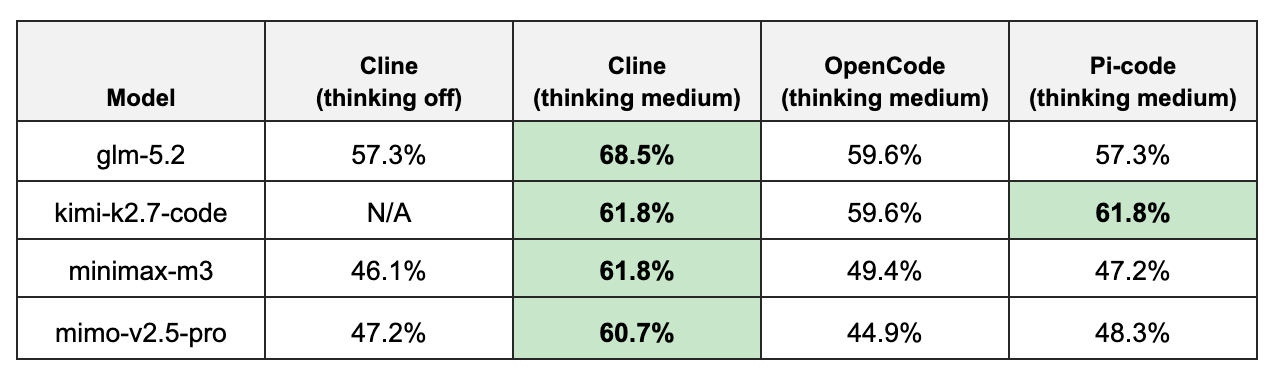
*Source: Cline team Terminal-Bench 2.0 full 89-task pass@1 runs on OpenRouter, June 2026; timeout multiplier 2.0, concurrency n=20.
*Harnesses: Cline CLI 3.0.29, OpenCode 1.17.9, Pi-Code 0.73.1. Full traces/artifacts: LINK.
During our SxS comparison with other agent harnesses, we see that Cline performs top-tier with open weight models. For example, GLM-5.2 with Cline and thinking off performs roughly in the same range as other agents with reasoning enabled. When we enable medium reasoning in Cline, the score moves meaningfully higher.
Throughout our investigation, we see that Cline handles one specific class of tasks dramatically better: tasks requiring sustained iterative problem-solving over many tool calls. In the traces we reviewed, Cline more often kept reasoning and action interleaved: think, act, observe, adjust, and continue, while for some other agents, some long reasoning bursts ended by hitting a length limit before any meaningful tool use or implementation happened.
We do not want to overclaim from one benchmark or a small number of examples. These results are early signals, and the Cline team is constantly committed to making Cline the best agent harness for open-weight models. You can view the full traces for those evaluation runs here: LINK.
Combined, Cline's harness and ClinePass point toward a future where agentic coding is more accessible to the open-source community and developers everywhere, while model choice stays open.
What ClinePass offers
ClinePass shows up as a separate provider inside Cline. After subscribing, you select it as the provider wherever you use Cline be it in the IDE, CLI or the SDK, and keep working.
The value is simple:
- Curated models that work for coding. GLM-5.2, Kimi K2.7 Code, Kimi K2.6, DeepSeek V4 Pro and Flash, MiMo V2.5 and V2.5-Pro, tested against agent workflows instead of picked from a catalog.
- Room to actually run agents. 2-5x API rate limits, stable access through Cline's infrastructure, and a flat $9.99/month subscription instead of worrying about every turn.
- No lock-in. ClinePass works across CLI, VS Code, JetBrains, and SDK, while still letting you bring your own keys, local models, or any other provider alongside it.
The curation is the part worth pausing on. GLM-5.2 and Kimi K2.7 running through Cline are producing work that, a year ago, we would have expected only from the frontier. These models are a powerhouse and with uninterrupted token streams with generous limits makes your coding workflows even more cheap and effective.
Still open, still yours
ClinePass doesn't change what Cline has always been. The extension, the CLI, and the SDK all point in the same direction: give developers a strong agent harness, keep it open, and let them choose how they use it.
Cline started open source and stayed open source. ClinePass is an entry point to better, more affordable AI, not a gate. If your team already uses OpenAI, Anthropic, Google, local models, or any other provider, ClinePass sits alongside that setup.
We're dedicated to making Cline the best place to explore open-weight models, at low cost. We believe coding and building should belong to everyone. Open-weight models are a major step toward that future.
Sign up for ClinePass today: LINK
You can try out ClinePass across all Cline surfaces, including IDE extensions and CLI. We are providing special discount for $1.99 via Cline CLI for a limited period: install via npm i -g cline!